
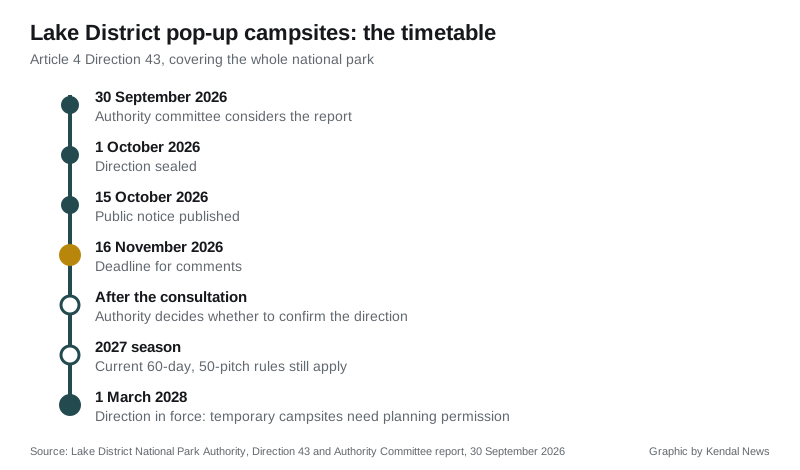
Pop-up campsites anywhere in the Lake District will need planning permission from 1 March 2028. Comments on the national park's direction close on 16 November.
Pop-up campsites in the Lake District will need full planning permission from 1 March 2028. The Lake District National Park Authority has made a direction that takes away the automatic right to run one, across the whole national park.
The public can comment until 16 November 2026. The authority then decides whether to confirm it. (Notice on the Public Notice Portal, 15 October 2026)
What changes
National planning rules let any landowner in England turn a field into a campsite without applying for planning permission, within limits. Under that right, known as Class BC, a site can run:
- for up to 60 days in a calendar year
- with up to 50 pitches
- with any movable structures it needs, such as toilet blocks and showers
The landowner has to provide toilets and waste disposal and tell the planning authority before opening each year. Unless the field is in a flood zone, there is no approval step. The rules set no minimum distance from neighbours and no standard for the facilities.
The national park’s direction, its 43rd under Article 4 of the planning rules, switches that right off inside the park. From March 2028 a temporary campsite there will need a planning application like any other development. (Direction 43, sealed 1 October 2026)
What it does not touch:
- campsites that already have planning permission
- wild camping above the fell wall, done responsibly
- anything allowed under a different class of the national rules, which the direction expressly leaves alone
Why the authority says it is needed
The authority received 47 notifications for temporary campsites in 2026. Its Head of Development Management, Andrew Smith, wrote in his report for the 30 September meeting that “whilst not all temporary recreational campsites cause problems, it is quite clear some do”. (Report to the Authority Committee, item 10)
The report says parish councils and residents complained through the summer about:
- noise, anti-social behaviour, fires and litter
- loss of privacy, with some sites next to homes and, in some cases, several campsites surrounding a single house
- field entrances onto roads too big or too small to be safe
National Highways raised sites opening straight onto trunk roads such as the A66 with no consent. Cumbria Fire and Rescue Service told planners there were no fire safety controls at all, such as spacing between pitches or extinguishers.
The complaints came from across the park, so the report says no part can be left out. It names:
- Bowness and Troutbeck, in the central Lakes
- near Staveley, at the south east entrance to the park
- Ullswater and Helton in the east
- Annaside in the west
- Newlands and Overwater in the north
- Nibthwaite in the south
The report also points to the scale of visiting: 18.11 million visitors and 27.21 million visitor days in 2023.
The arguments for pop-up sites, and the answers
The report accepts that temporary sites give people cheap places to camp at the busiest times. It weighs three other claims made for them:
- That they cut fly-camping. The report is “unpersuaded”. Fly-camping remains a serious local concern, it says, despite rules that let temporary sites open “essentially without approval”.
- That they take motorhomes off laybys. “Possible”, the report says, but unproven.
- That they bring income. Likely, for landowners, but with “no guarantee” it is reinvested for public good.
It lists the risks on the other side. Some existing sites may not be able to operate. Campers and campervans may be displaced. Visitors who would have used temporary sites may not come, which would hit landowners and the wider local economy.
Why it waits until 2028
If permitted development rights are withdrawn with less than 12 months’ notice, the authority must pay compensation when it later refuses an application that would have been allowed before. Because Class BC covers most of the land in the park, and the Local Plan rarely allows new campsites, the report says refusals are “a genuine possibility”. The cost of an immediate direction could not be estimated.
A start date more than a year away removes that risk. It also leaves the 2027 season untouched.
Under the Local Plan, a new campsite is normally allowed only in the west of the park, or where it helps diversify a farm, rural business or pub, and only if it is screened and the roads can take it. The report says that in practice “policy compliant opportunities are therefore limited”.
A middle way the authority has not ruled out
The report sets out an alternative that members could still take up: a Local Development Order. It would grant permission for temporary campsites across the park, much as the national rules do now, but with conditions such as minimum distances between campsites and homes.
The report says such an order would not stop all the problems, and that “some of the most complained about” sites would probably still qualify. It makes no recommendation. An order for the 2028 season would not need to be made until late 2027.
What it means for you
- If you run a pop-up site inside the park, nothing changes for the 2026 or 2027 seasons. From 1 March 2028 you will need planning permission before you open, and the Local Plan sets a high bar for new campsites.
- If a temporary site next to your home has caused problems, this is the authority’s response, and the consultation is the place to say so with specifics: where, when and what happened.
- To comment, email planning@lakedistrict.gov.uk or write to the Lake District National Park Authority, Murley Moss Business Park, Oxenholme Road, Kendal, LA9 7RL, before 16 November 2026. The direction and its map can be seen at Murley Moss during office hours, or on the authority’s consultation page.
- Kendal itself is not affected. The town is outside the national park, so Westmorland and Furness Council remains the planning authority and the national 60-day right still applies there. Windermere, Bowness, Ambleside, Grasmere, Coniston and Hawkshead are all inside the park.
The authority’s website says the direction was made on 30 September, the date of the committee meeting. The sealed direction and the statutory notice both give 1 October.
For planning decisions closer to home, see our Kendal planning news page.
Have your say